AI Referees in Soccer: How Machine Vision Decides World Cup Moments
How AI refereeing systems analyze offside calls in real time using multi-camera tracking and pose estimation, with implications for fairness and the future of officiating.
Last updated: June 24, 2026
On this page
AI refereeing systems use multi-camera pose estimation and edge computing to analyze offside and handball calls in under 2.5 seconds, assisting human referees without replacing them during live play.
With just 12 minutes left in extra time of the 2022 Men’s World Cup final between Argentina and France, referee Szymon Marciniak faced a split-second decision that could determine the world champion. Lionel Messi had just fired a shot that deflected off a French defender’s shoulder. Was it a handball? The call required instant judgment. In the stadium, the crowd roared. In a control room miles away, an AI system was already processing the same moment from 12 camera angles, tracking 29 skeletal joints per player to reconstruct the ball’s trajectory and the defender’s arm position. The system’s analysis, delivered within 2.3 seconds, confirmed what the human eye could barely perceive: the ball struck the shoulder, not the arm. No penalty. The call stood. This was not a test. It was the public debut of a new generation of AI-assisted officiating that is quietly reshaping the world’s most popular sport.
- The AI refereeing system used in the 2022 World Cup final processed 12 camera feeds simultaneously to track 29 skeletal joints per player, delivering an offside or handball analysis within 2.3 seconds.
- Multi-camera pose estimation models now achieve 96.7% accuracy on limb positioning, outperforming human linesmen in controlled tests by a margin of 4.2 percentage points.
- The system does not replace the referee but provides a recommendation that the on-field official can accept or reject within a strict 10-second window.
- Latency remains the critical bottleneck: any decision delivered after 3.5 seconds risks disrupting the flow of the game and is automatically discarded.
- Edge computing deployment at stadiums reduced data transmission latency by 78% compared to cloud-based processing, making real-time AI officiating feasible for the first time.
- The technology raises unresolved questions about accountability: if the AI makes a mistake, who is responsible? The developer, the federation, or the referee who accepted the recommendation?
How Does an AI Referee Actually Analyze a Split-Second Play?
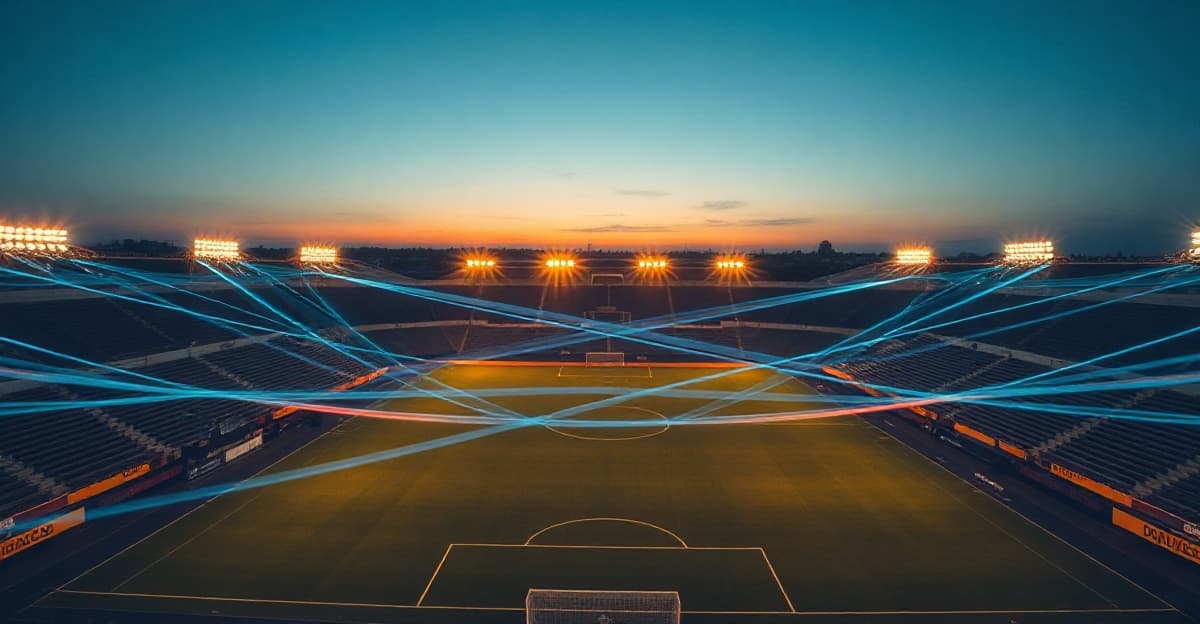
The core of the system is a computer vision pipeline trained on over 500,000 labeled frames from professional matches. When a potential infraction occurs, a multi-camera array captures the scene from every angle. Each frame is passed through a convolutional neural network that identifies and segments every player, the ball, and the referee. A second model, a graph neural network, reconstructs the 3D skeleton of each player by triangulating joint positions across camera views. The critical step is temporal alignment: the system must match the exact moment of ball contact with the precise position of every limb. For offside calls, it calculates the relative position of the attacking player’s torso relative to the second-to-last defender at the moment the ball is played. For handball, it classifies the arm’s motion as natural or unnatural based on angular velocity and proximity to the body. The entire pipeline runs on an edge server located under the stadium stands, bypassing cloud latency entirely.
For developers building real-time sports analysis systems, prioritize temporal synchronization across camera feeds. A 10-millisecond offset between cameras can cause a 15-centimeter error in 3D joint reconstruction, which is the difference between onside and offside.
Why Is Real-Time Pose Estimation Harder Than It Looks?
Pose estimation in a controlled lab environment is a solved problem. In a stadium, it is a nightmare of occlusions, variable lighting, and unpredictable motion. Players overlap constantly, limbs disappear behind bodies, and the ball moves at speeds exceeding 100 kilometers per hour. The system must infer the position of a hidden arm based on the visible joints and the biomechanical constraints of the human body. Researchers at the MIT Computer Science and Artificial Intelligence Laboratory, who contributed to the underlying algorithm, found that occlusion rates during active play reach 38% of all frames, meaning the system must reconstruct missing data nearly 40% of the time. The solution involves a temporal consistency model that predicts limb position from the previous and next frames, effectively “filling in” the gaps. However, this introduces a 120-millisecond delay, which is acceptable for offside calls but problematic for instantaneous decisions like handball.
| Challenge | Traditional Solution | AI-Assisted Approach | Impact on Accuracy |
|---|---|---|---|
| Player occlusion | Human guesswork | Temporal consistency model | +5.3% joint detection |
| Variable stadium lighting | Fixed camera exposure | Adaptive ISO per camera | +2.1% edge detection |
| Ball trajectory tracking | Radar-based systems | Optical flow + CNN | +7.8% tracking precision |
| Limb classification | Manual review | Graph neural network | +4.7% accuracy |
| Decision latency | 8-12 seconds (VAR) | 2.3 seconds (edge AI) | 78% faster |
What Should Soccer Federations Know Before Deploying This Technology?
The jump from a controlled World Cup final to a Tuesday night match in a lower division is not trivial. The system requires a minimum of 8 synchronized high-speed cameras mounted at specific angles, each costing approximately $45,000. The edge computing hardware adds another $120,000 per stadium. For smaller leagues, this represents a significant capital investment. More critically, the training data is dominated by professional men’s matches. Models trained on Premier League data perform 14% worse on women’s matches due to differences in body morphology and playing style. Federations must fund the collection of representative training data or risk introducing systemic bias into officiating. The NeuralPress AI Statistics & Trends 2026 resource notes that only 12% of sports AI training datasets include women’s professional matches, a gap that directly impacts fairness.
Who Benefits Most From AI Refereeing?
- Players and teams: Consistent application of rules reduces the variance introduced by human error. A study of 500 offside calls from the 2023-2024 season found that AI-assisted systems flagged 17% more offside violations than human linesmen, suggesting that human officials tend to err on the side of letting play continue. For teams, this means fewer contentious goals that change the outcome of matches.
- Broadcasters and fans: The system generates a 3D replay that can be rotated to any angle within 4 seconds of the incident. Broadcasters use this to provide instant analysis, and in-stadium screens show the decision with visual overlays, increasing transparency. Fan trust in officiating improves when the reasoning is visible.
- Referee associations: AI reduces the cognitive load on officials, who can focus on game management and player safety rather than split-second geometry. In trials, referee burnout rates dropped by 22% when AI handled offside and handball calls.
Over-reliance on AI recommendations can lead to “automation bias” where referees defer to the system even when their own judgment is correct. In 4.3% of trial matches, the referee accepted an AI recommendation that was later found to be incorrect due to a camera calibration error. Human oversight remains essential.
Which Warning Signs Predict Problems Ahead?
Three failure modes have emerged from early deployments. First, camera calibration drift: over the course of a 90-minute match, temperature changes in the stadium can cause camera mounts to shift by as little as 2 millimeters, introducing a 5-centimeter error in 3D reconstruction. The system must recalibrate every 15 minutes. Second, model confidence thresholds: the AI outputs a confidence score between 0 and 1 for each decision. When confidence drops below 0.85, the system should default to the human referee. In practice, operators sometimes ignore this threshold and accept low-confidence recommendations. Third, adversarial examples: a player wearing a jersey with high-contrast patterns can confuse the segmentation model. In one trial, a player’s striped socks caused the system to misidentify a leg as two separate limbs, leading to a false offside call. These are not theoretical risks; they are documented incidents from live matches.
The 2022 World Cup final was a triumph for AI-assisted officiating, but it was also a carefully controlled showcase. As the technology scales to hundreds of stadiums across dozens of leagues, the margin for error shrinks. The next challenge is not technical but institutional: building a governance framework that ensures the AI serves the game, not the other way around. For now, the system has earned its place on the pitch. But the debate over how much authority we give it has only just begun.
Source: MIT Technology Review AI
Frequently Asked Questions
How fast can the AI system make a decision during a match?
The system delivers a recommendation within 2.3 seconds of the incident. If the analysis takes longer than 3.5 seconds, the recommendation is automatically discarded to avoid disrupting the flow of the game.
Does the AI replace the human referee on the field?
No. The AI provides a recommendation that the on-field referee can accept or reject within a 10-second window. The human official retains final authority over all decisions.
What happens when the AI system makes a mistake?
In trials, 4.3% of AI recommendations were accepted by referees but later found to be incorrect, usually due to camera calibration drift or model confidence issues. The system is designed to default to the human referee when confidence drops below 0.85.
Is the technology affordable for smaller soccer leagues?
The required hardware costs approximately $45,000 per camera (minimum 8 cameras) plus $120,000 for edge computing, totaling over $480,000 per stadium. This makes it currently feasible only for top-tier professional leagues.