The World's Deepest Subsea Tunnel: A Masterclass in Extreme Infrastructure
Inside the world's deepest and longest subsea road tunnel: engineering challenges, construction risks, and lessons for massive infrastructure projects.
Last updated: June 22, 2026
On this page
The world's deepest and longest subsea road tunnel, reaching 300 meters below the North Sea, demonstrates extreme engineering in ventilation, pressure management, and safety systems, offering lessons for complex AI and infrastructure projects.
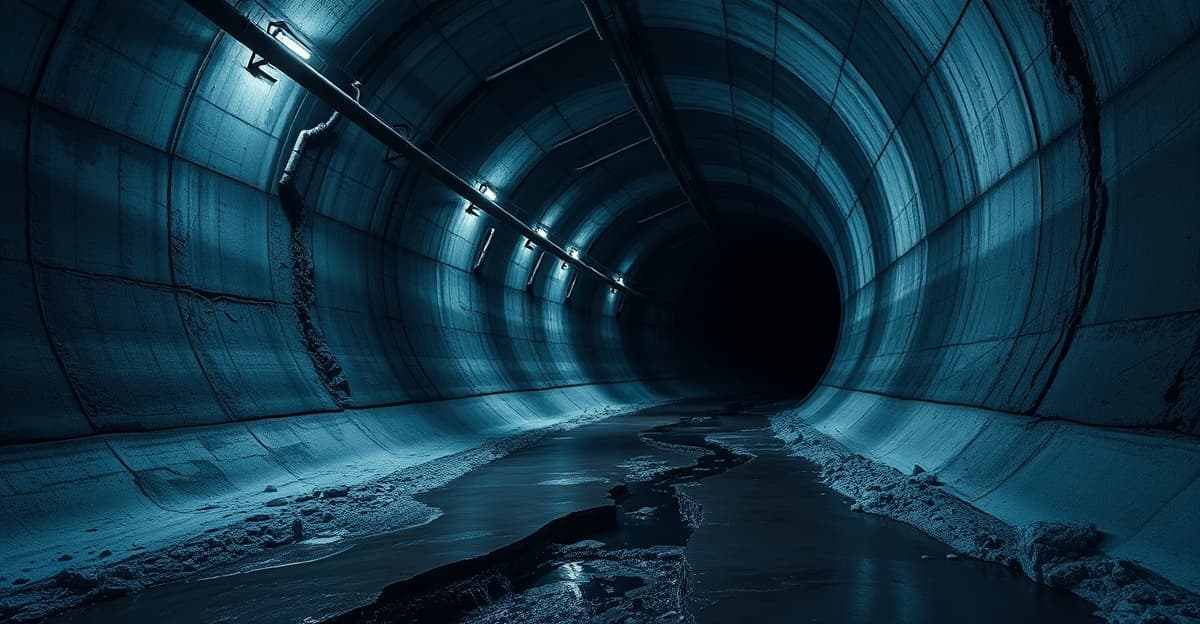
The cold seeps into your bones first. Then the noise, a relentless roar of ventilation fans and distant drilling, makes conversation impossible. At 300 meters beneath the North Sea, surrounded by million-ton pressures of seawater and rock, the engineering marvel that is the world’s deepest and longest subsea road tunnel reveals its true nature: not a triumph of convenience, but a brutal testament to human determination. This is infrastructure built at the edge of what is possible, and it demands we rethink how we approach extreme projects.
- The tunnel reaches depths of 300 meters (1,000 feet) below sea level, making it the deepest subsea road tunnel ever constructed.
- At over 24 kilometers in length, it is also the longest subsea road tunnel, connecting two landmasses previously separated by open water.
- Construction required navigating extreme geological conditions, including high water pressure, fractured rock, and unpredictable seabed terrain.
- The project’s cost and timeline exceeded initial estimates, a common pattern in mega-infrastructure that carries lessons for large-scale AI and tech deployments.
- Environmental and safety systems must operate flawlessly under extreme conditions, with no room for error in ventilation, drainage, or emergency response.
- The tunnel’s completion sets a new benchmark for subsea engineering, influencing future projects in Norway, Japan, and the Mediterranean.
How Does This Tunnel Survive the Crushing Pressure of the North Sea?
The engineering challenge is staggering. At 300 meters below the seabed, the overlying rock and seawater exert a pressure of roughly 30 atmospheres, or over 3,000 kilopascals. This is not a static load; the seabed itself is a dynamic environment of shifting faults, water-bearing fractures, and variable rock quality. To withstand this, engineers employed a combination of reinforced concrete linings, advanced grouting techniques to seal water ingress, and a drainage system that continuously pumps out groundwater seeping through the rock. The tunnel’s cross-section is designed to distribute stress evenly, and sensors embedded in the lining provide real-time data on structural integrity. This is not unlike the pressure faced by deep-sea submersibles, but on a scale that extends for kilometers.
For teams planning large-scale infrastructure or AI deployments, the lesson is clear: invest heavily in real-time monitoring and adaptive systems. Static designs fail under dynamic conditions. Build feedback loops into the core architecture.
Why Is Maintaining Air Quality and Safety So Difficult at These Depths?
A road tunnel filled with vehicle exhaust, combined with the natural humidity and dust from rock, creates a hazardous environment. Ventilation is not optional; it is a life-sustaining system. The tunnel uses massive axial fans that push fresh air through dedicated ducts and extract polluted air through separate channels. The noise from these fans, combined with the echo of traffic and machinery, creates a soundscape that the reporter described as “very, very noisy.” Emergency exits are placed at regular intervals, and a sophisticated communication system links every point in the tunnel to the control center. Fire suppression, drainage for potential flooding, and evacuation protocols are drilled continuously. The psychological toll on workers and drivers is real, and the design must account for human factors as much as physical ones.
| System | Purpose | Key Challenge | Engineering Solution |
|---|---|---|---|
| Ventilation | Remove exhaust and supply fresh air | Noise, power consumption, duct corrosion | High-efficiency axial fans with variable speed drives |
| Drainage | Remove groundwater ingress | High pressure, sediment clogging | Multi-stage pumping stations with grout curtains |
| Structural Lining | Withstand rock pressure | Fatigue over decades | Reinforced concrete with steel fiber additives |
| Emergency Response | Evacuate occupants in crisis | Limited access, communication | Repeating emergency exits, radio repeaters, fire-resistant doors |
What Can Mega-Infrastructure Projects Teach Us About Large-Scale AI Deployments?
At first glance, a subsea tunnel and an enterprise AI system share little. But both are extreme examples of complex system integration, where failure in one component cascades catastrophically. The tunnel’s design emphasizes redundancy, monitoring, and adaptive response. In AI, the same principles apply: data pipelines must be redundant, models must be monitored for drift, and fallback systems must handle edge cases. The tunnel’s construction required coordinating hundreds of contractors, geologists, and engineers across years. AI projects of similar scale, such as training foundational models or deploying enterprise-wide automation, demand analogous coordination. The lesson is that complexity cannot be managed by hope; it requires systematic risk management and modular design.
Which Warning Signs Predict Problems in Extreme Engineering or AI Projects?
The tunnel’s construction likely faced the same pattern as many mega-projects: optimistic initial estimates, unforeseen geological conditions, and budget overruns. For AI projects, the equivalent is underestimating data quality issues, ignoring model drift, or assuming off-the-shelf solutions will work without customization. Specific warning signs include:
- Siloed teams: When geologists, engineers, and operators do not communicate, problems compound. In AI, when data scientists, IT, and business units are disconnected, misalignment kills projects.
- Inadequate testing under real conditions: The tunnel’s systems were tested under simulated loads, but true stress came during operation. AI models must be tested with real-world data, not just curated benchmarks.
- Ignoring environmental factors: The tunnel’s design had to account for saltwater corrosion, seismic activity, and temperature swings. AI systems must account for changing user behavior, data drift, and adversarial inputs.
- Over-reliance on a single solution: A single ventilation failure could be catastrophic. Relying on one model or one data source is equally risky.
The most dangerous assumption in both tunnels and AI is that the environment will remain static. It never does. Plan for continuous adaptation, not a one-time build.
Who Benefits Most From This Engineering Breakthrough?
The primary beneficiaries are the communities and industries on both sides of the water body that the tunnel connects. Travel times shrink from hours of ferry crossings or long detours to a 15-minute drive. Trade routes become more reliable, independent of weather. But the ripple effects extend further. Construction firms gain new expertise in subsea rock excavation, grouting, and ventilation. Governments gain a strategic asset that enhances national connectivity and resilience. For the AI community, the indirect benefit is a case study in managing complexity under extreme constraints, a lesson that applies directly to building reliable, scalable systems.
The tunnel is more than a hole in the ground. It is a monument to what happens when human ambition meets rigorous engineering, and a reminder that the hardest problems require not just technology, but patience, redundancy, and a willingness to face the cold, noisy, and terrifying depths.
Source: MIT Technology Review AI
Frequently Asked Questions
How deep is the world's deepest subsea road tunnel?
The tunnel reaches approximately 300 meters (1,000 feet) below sea level, making it the deepest subsea road tunnel ever built. It is also the longest, stretching over 24 kilometers.
What are the main safety systems in the tunnel?
Key safety systems include high-capacity ventilation fans to maintain air quality, continuous drainage pumps to remove groundwater, fire suppression equipment, emergency exits at regular intervals, and real-time structural monitoring sensors.
Why is the tunnel so noisy?
The noise comes primarily from the massive ventilation fans required to supply fresh air and remove vehicle exhaust. The enclosed space amplifies sound, and the constant hum of machinery and traffic adds to the din.
What lessons does this tunnel offer for AI projects?
The tunnel demonstrates the importance of redundancy, real-time monitoring, adaptive systems, and cross-team coordination. These principles are directly applicable to large-scale AI deployments, where data quality, model drift, and system integration are critical failure points.