AI as a Time Machine: Resurrecting Lost Civilizations with Machine Learning
Explore how AI archaeology deciphers ancient scrolls, translates dead languages, and reconstructs ruins, transforming history preservation.
Last updated: May 25, 2026
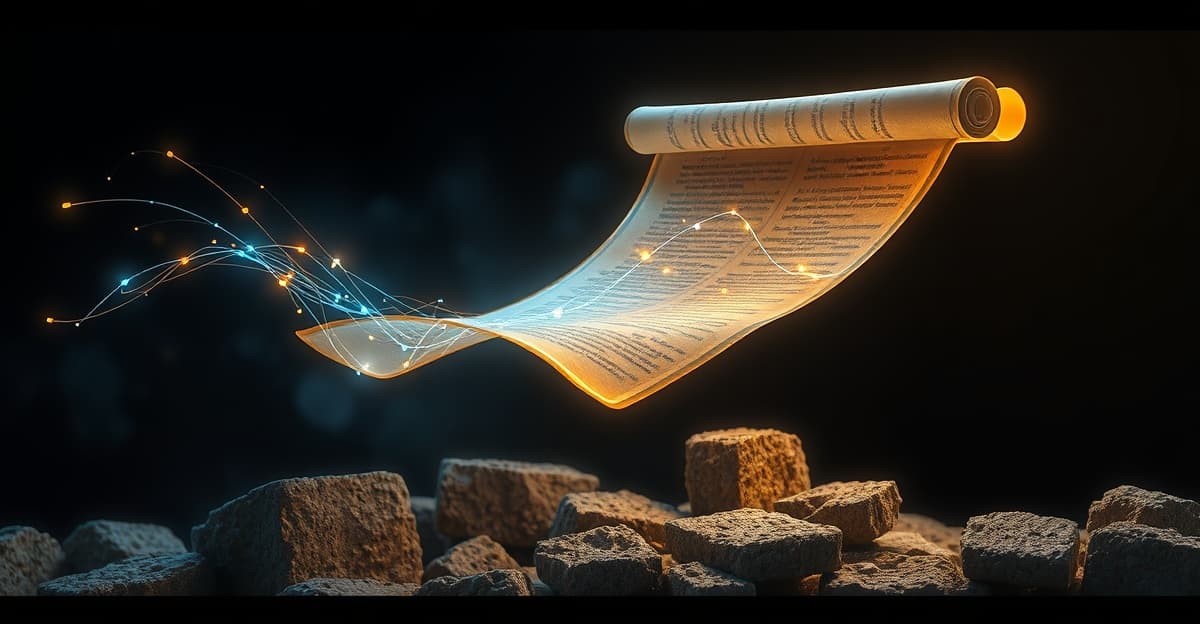
AI archaeology uses machine learning to decipher unreadable ancient texts, translate lost languages, and reconstruct ruins, turning data science into a tool for recovering lost history.
The past is not silent. It whispers through fragmented pottery, charred papyrus, and crumbling stone. For centuries, historians and archaeologists have strained to hear those whispers, often coming away with little more than educated guesses. Now, a new discipline is emerging that turns data science into a time machine. AI Archaeology uses advanced machine learning models to resurrect lost history, deciphering what was once unreadable and reconstructing what was once shattered. This is not science fiction. It is a quiet revolution taking place in labs and museums, where algorithms are becoming the most powerful tools ever wielded in the quest to understand human civilization.
Unrolling the Unreadable: AI Deciphers Ancient Scrolls
The most dramatic victories of AI archaeology come from the most hopeless cases. Consider the Herculaneum scrolls, a library of papyrus texts carbonized into brittle, rock-hard lumps by the eruption of Mount Vesuvius in 79 AD. For centuries, any attempt to unroll them resulted in dust. Enter machine learning. Researchers trained computer vision models on high-resolution CT scans of the scrolls, teaching the algorithms to detect the subtle differences in density between the carbon-based ink and the carbonized papyrus. The result was a breakthrough: the first readable words from a scroll that had been a sealed black cylinder for nearly two thousand years. This technique, known as virtual unwrapping, does not just recover letters. It recovers entire philosophical texts, poetry, and historical records that were thought lost forever. The implications are staggering. Dozens of scrolls await analysis, and each one could rewrite chapters of ancient history.
Cracking Dead Languages Without a Rosetta Stone
Translating a dead language usually requires a bilingual text, a key that maps one language onto another. But what happens when no such key exists? This is the challenge of undeciphered scripts like Linear A from Minoan Crete or the Indus Valley script. AI is now providing a way forward. Researchers apply natural language processing techniques, treating unknown scripts as a statistical puzzle. By analyzing patterns of character co-occurrence, word boundaries, and syntactic structures, neural networks can infer grammatical rules and semantic relationships without ever knowing what a single word means. For example, models trained on known languages can be adapted to detect patterns in undeciphered texts, generating hypotheses about whether a script is logographic, syllabic, or alphabetic. This approach does not produce a perfect translation, but it narrows the search space dramatically. It gives linguists a probabilistic map of the language’s structure, turning a dead end into a directed investigation. The method has already yielded promising results on scripts like Proto-Elamite, suggesting that AI may one day unlock the voices of entire civilizations that have had no voice for millennia.
Rebuilding Ruins: Virtual Reconstruction from Fragments
Archaeological sites rarely yield intact structures. They yield fragments: a column base here, a wall section there, thousands of scattered pottery shards. Reassembling these pieces by hand is painstaking and often impossible. AI excels at this kind of combinatorial puzzle. Computer vision models can scan 3D models of fragments and match them based on curvature, texture, and fracture patterns, much faster and more accurately than a human can. More impressively, generative adversarial networks can fill in the missing pieces. Given a set of ruins, an AI can learn the architectural style of a culture and then generate a plausible reconstruction of the complete structure, from temples to entire city blocks. Museums are already using these reconstructions to create immersive virtual reality exhibits. Visitors can walk through a digital reconstruction of a temple that exists only as a few broken stones in reality. This is not just a visual aid. It is a testable hypothesis. When an AI reconstructs a building, archaeologists can examine the result for structural or historical plausibility, refining their understanding of how people actually lived.
Changing How Museums Tell the Story
The impact of AI archaeology extends beyond the lab and into the public square. Museums are beginning to integrate these digital reconstructions and translated texts into their exhibits, offering visitors a richer, more dynamic view of history. Instead of a glass case with a few shards and a label, visitors can see an AI-generated animation of how a pot was used in a daily ritual, or read a freshly translated poem from a scroll. This changes the narrative from one of loss to one of recovery. History is no longer just what survived by accident. It is what we can actively retrieve. The role of the curator is also shifting. Curators now work alongside data scientists to train models on their collections, creating digital archives that are not static but generative. These archives can answer questions: What did this tool actually do? How did this building look from the inside? The result is a more interactive and evidence-based dialogue with the past.
What to Watch Next: The Convergence of AI and Deep History
The next frontier for AI archaeology is integration. We are moving toward unified platforms that combine translation, reconstruction, and contextual analysis. Imagine a system that reads a newly unearthed tablet, translates it, and then cross-references its content with known historical events to suggest a date and provenance, all in real time. The ethical dimensions are also becoming clearer. Who owns the digital reconstruction of a temple? Who controls the narrative when an AI fills in the gaps? These questions will define the next decade of the field. For now, the clear trajectory is that AI is not replacing archaeologists. It is giving them superpowers. The deep past, once considered a realm of static artifacts and fixed interpretations, is becoming a dynamic data science problem. And as the algorithms get better, the voices of our ancestors will only grow louder.
Frequently Asked Questions
How does AI read a carbonized scroll without unrolling it?
AI uses computer vision on high-resolution CT scans to detect subtle density differences between ink and papyrus, a process called virtual unwrapping. This allows researchers to read text from scrolls that are too brittle to physically open.
Can AI translate a language with no known bilingual text?
Yes, partially. AI analyzes statistical patterns in the script, such as character frequency and syntax, to infer grammatical rules and meaning. This produces a probabilistic map of the language rather than a perfect translation, but it provides a crucial starting point for linguists.
How accurate are AI reconstructions of ancient ruins?
AI reconstructions are hypotheses based on learned architectural styles and fragment matching. They are highly useful for visualization and testing ideas, but they require validation by archaeologists. Accuracy improves as more fragment data and contextual information are fed into the model.
Will AI replace human archaeologists and historians?
No. AI serves as a powerful tool that automates tedious tasks like fragment matching and pattern recognition, but it cannot replace human expertise in interpretation, context, and ethical judgment. The best results come from collaboration between AI and domain experts.